





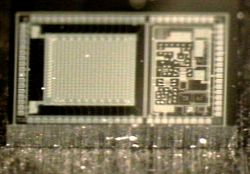
To achieve a high dynamic range in image acquisition, logarithmic response functions can be implemented which project the huge variations of input light intensities on a relatively small interval of output voltages. This concept is problematic for scenes with small spatial light variations giving rise to images with very low contrast. Biological systems can adapt the slope of their logarithmic response functions. Steady signals are treated with a rather flat logarithmic response curve whereas transient signals are amplified more in order to use the available range for the output signal in a most efficient way.


 HOME
HOME
