Navigation


KIP - Cryogenic particle detection - TES
|
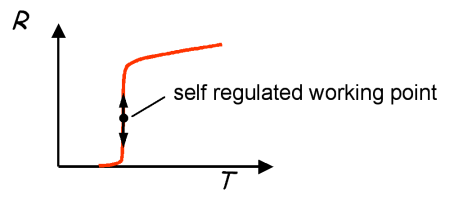
Superconducting Transition Edge Sensors Another branch of resistive calorimeters are superconducting transition edge sensors (TES), which are operated at the transition between superconducting and normal states. The main advantage of these devices is the fact that resistance change R(T) at the superconducting transition can be made very steep and thus the sensitivity of the thermometer can be very high (Fig. 1). In many cases bilayers of normal and superconducting metals are used, since only few superconductors have suitable transition temperatures for use in low temperature calorimeters. Because of the proximity effect the transition temperature of the bilayer is reduced compared to that of the superconductor. By choosing an appropriate thickness of each layer, the transition temperature can be tuned to the desired operating point. In general, TES have problems of transition non-linearity and limited dynamic range. These problems can be overcome by the so-called negative electrothermal feedback. When a TES is voltage biased and the substrate is cooled to well below the transition temperature, a stable equilibrium is established when heating of the TES by its bias current matches the heat flow from the film into the substrate. Upon the deposition of energy in the absorber by a particle, the temperature and resistance of the TES increase with a corresponding decrease in the current, and thus a reduction in the Joule heating. The feedback signal is the change in Joule power heating in the film, which is the product of the bias voltage and the measured current. In this way one has a self-stabilizing system. An additional advantage is the possibility of reducing the signal recovering time with this technique. |
|
University of Oxford, England
Max-Planck-Institut für Physik, Munich Technische Universität München NIST Boulder, USA SRON, Netherlands |
|